Building Confidence, One Support Case at a Time
A new support engineer has a lot to learn at once. There is the product, the ticket queue, the investigation process, and the customer waiting for an answer. Knowing where to begin can be just as challenging as knowing the technology.
Part of my work at Acquia is helping Associate Support Specialists navigate that beginning. I have helped build up our newly created Tier 1 team by guiding new colleagues through the work of customer support, introducing the technology behind our products, and being available when a case becomes difficult.
For me, mentoring is about helping someone understand how to reach an answer—and feel comfortable asking for help along the way.
Start with the person behind the ticket
Before diving into Drupal or platform logs, I help new colleagues understand what the customer support department does each day. A case involves more than a technical question. It involves expectations, communication, ownership, and often a customer who is under pressure themselves.
I encourage associates to begin by understanding what the customer is trying to achieve. What has stopped working? What is the impact? What have they already tried? A careful question can save a long investigation in the wrong direction.
Empathy belongs in that process. A customer may describe a problem imperfectly or be frustrated after repeating it. Our responsibility is to listen, clarify, and help them move forward. Technical knowledge becomes much more useful when the customer trusts the person applying it.
Make the technology understandable
Drupal is a large ecosystem. For someone starting out, it can be difficult to separate application behaviour from configuration, contributed modules, custom code, or the hosting platform.
I help associates develop that understanding and then use it to investigate customer issues more deeply. The aim is to connect what they observe with the next useful question. What evidence supports this explanation? What else could produce the same symptom? What would help us narrow it down?
I want colleagues to be able to explain their reasoning, rather than simply repeat a troubleshooting step. That understanding is what helps them when the next case looks different.
Connect Drupal to the platform around it
Customers experience a complete service, even when the underlying products have different responsibilities. Mentoring therefore also means helping associates understand Acquia Cloud Platform, including its Kubernetes-powered infrastructure, and how the wider product ecosystem fits together.
My guidance covers products such as Acquia Code Studio, Pipelines, Acquia Solr search, and Acquia DAM. The focus is on building a useful mental model: what each product does, where a problem might sit, and when to bring in additional expertise.
I also support colleagues preparing for the Acquia Cloud Pro and Drupal Site Builder certifications. Certification preparation gives learning some structure; discussing real support questions helps connect that learning to day-to-day work.
Be available when the case gets difficult
I act as a first point of contact when an associate needs technical guidance or a customer escalates their case. Those moments are opportunities to help both the customer and the engineer.
My approach is to work through the context together: what we know, what remains uncertain, and what we should do next. The associate should leave with a clearer understanding of the investigation, not just a response to paste into a ticket.
Building a new Tier 1 team requires that kind of ongoing support. Initial training is only the beginning. Questions change as people take on more cases and encounter new situations. Being approachable matters just as much as having an answer.
Recognition that connects service and mentoring
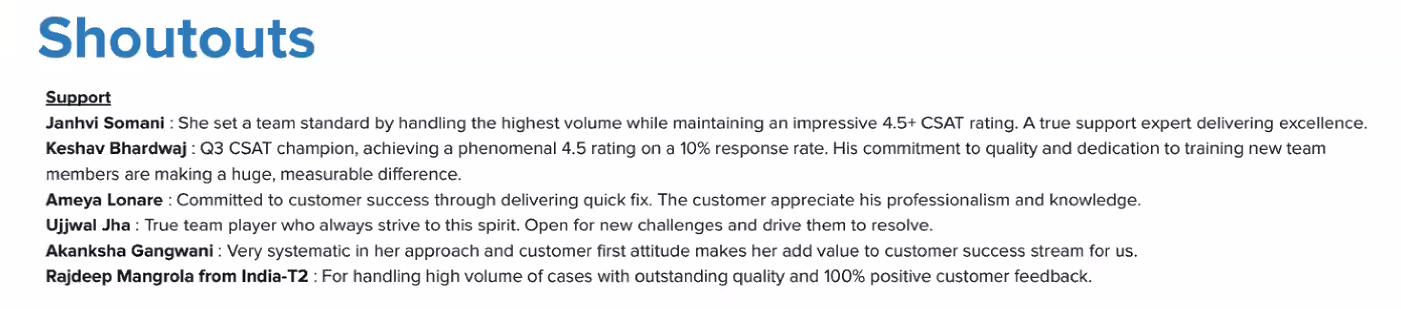
An internal Q3 shoutout recognized me as a CSAT champion and specifically acknowledged my commitment to training new team members. What means most to me is that those two contributions were recognized together.
Customer feedback tells a similar story about the value of careful support. One customer thanked me for following through with their team and New Relic. Another described how a discussion and subsequent investigation helped them understand the cause of an issue and how to prevent it from happening again.
These are selected examples of feedback, rather than a claim about every interaction. They reinforce the habits I want to pass on: listen closely, investigate carefully, explain clearly, and follow through.
The kind of technical leader I want to be
My experience in support continues to shape how I think about leadership. Technical depth matters. So does making that knowledge accessible to someone who is still learning.
As I deepen my work in DevOps and reliability engineering, I want to carry both forward. I want to build better systems and help the people operating them become more confident, curious, and independent.
For me, a meaningful part of progress is the moment a colleague can explain a difficult issue in their own words—and knows they have someone to turn to when the next question arrives.
Moments of recognition
The feedback that stays with me recognizes both sides of support: helping a customer through a difficult issue and helping a colleague build confidence.
Browse my achievements and customer feedback collection on Google Drive.
Recognition refers to an internal Q3 shoutout; the source does not identify the year. These are my personal reflections on supporting and mentoring colleagues, not an official statement from Acquia.